What if a town decided it was safe to talk?
There are things we're good at talking about in a small town, and then there are the things many of us have become very good at carrying quietly.
Anxiety. Loneliness. Grief. Money. Relationships. Work. Family. The days when we're not doing particularly well, but tell everyone we're fine anyway.
You Can Talk Here is a simple idea for Bicheno: make talking openly about mental health an ordinary part of looking after one another.
Not counselling. Not another awareness day. Just a town trying to make it a little easier to say: Actually, I'm not going that well.
Why?
Because the numbers are hard to ignore.
52.9%
of Tasmanians aged 16–85 reported experiencing a diagnosable mental health challenge at some point in their lives.
33.7
Deaths per 100,000 people. (The five-year male suicide rate cited for the statistical region encompassing Glamorgan–Spring Bay and Tasmania's rural south-east, including Bicheno).
At the time, it was the third-highest such rate in Australia.
Those numbers don't tell us why any individual person struggles.
But they do tell us something:
Places like ours are carrying more than they should have to.
And while we can't solve every problem from Bicheno, perhaps there is one distance we can make a little smaller.
The distance between one another.
Interested in reading more? Link to The Unbuttoning article (Mental Health and East Coast Tasmania).
Make Talking Ordinary
Most difficult days don't have names. They're ordinary Tuesdays or Thursdays. They're sitting in the car for ten minutes before going inside. They're the walk home. The coffee that unexpectedly becomes a conversation. The person who normally has plenty to say being unusually quiet. The phone call you almost didn't make.
Suicide prevention isn't a day. It's all the ordinary moments when somebody notices somebody else.
You don't need to be a counsellor. You don't need to have the perfect words. Sometimes we can start with three very simple things:
You Can Talk Here
It isn't an accreditation.
It doesn't mean there's a counsellor inside.
And it doesn't mean the organisation or person displaying it has all the answers.
It simply means that the space inside/outside is an incubator for authentic conversations.
A small, visible signal that this is somewhere you don't have to pretend.
Put It on Your Door.
The mark is simple.
It says that this place is part of a town choosing to push back against the mental-health statistics that too often define rural and regional communities.
It doesn't mean the person behind the counter is a counsellor.
It doesn't mean anyone here has all the answers.
It simply means vulnerable conversations are welcome here.
That if someone says they're not travelling well, the conversation doesn't need to become awkward, hidden or hurried away.
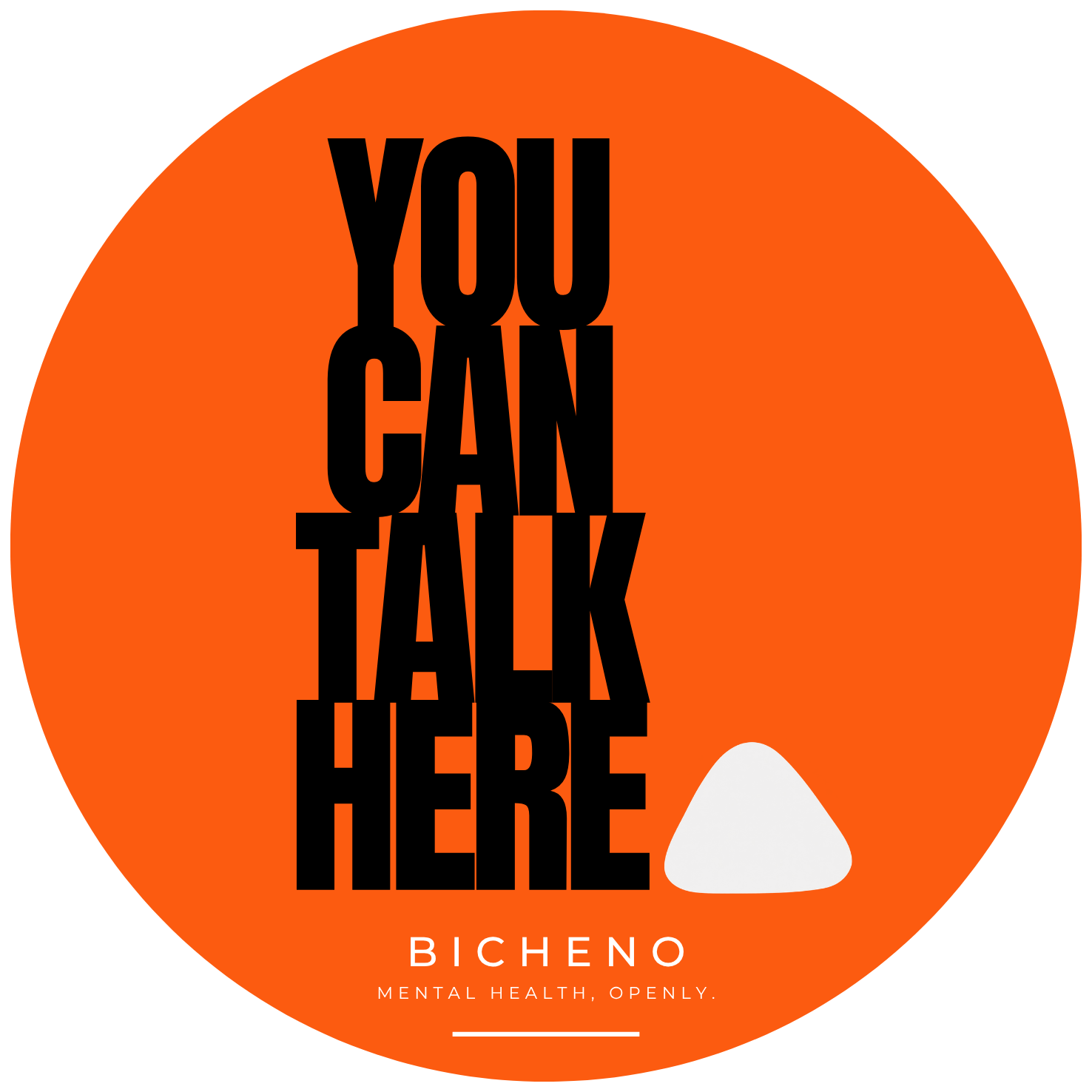
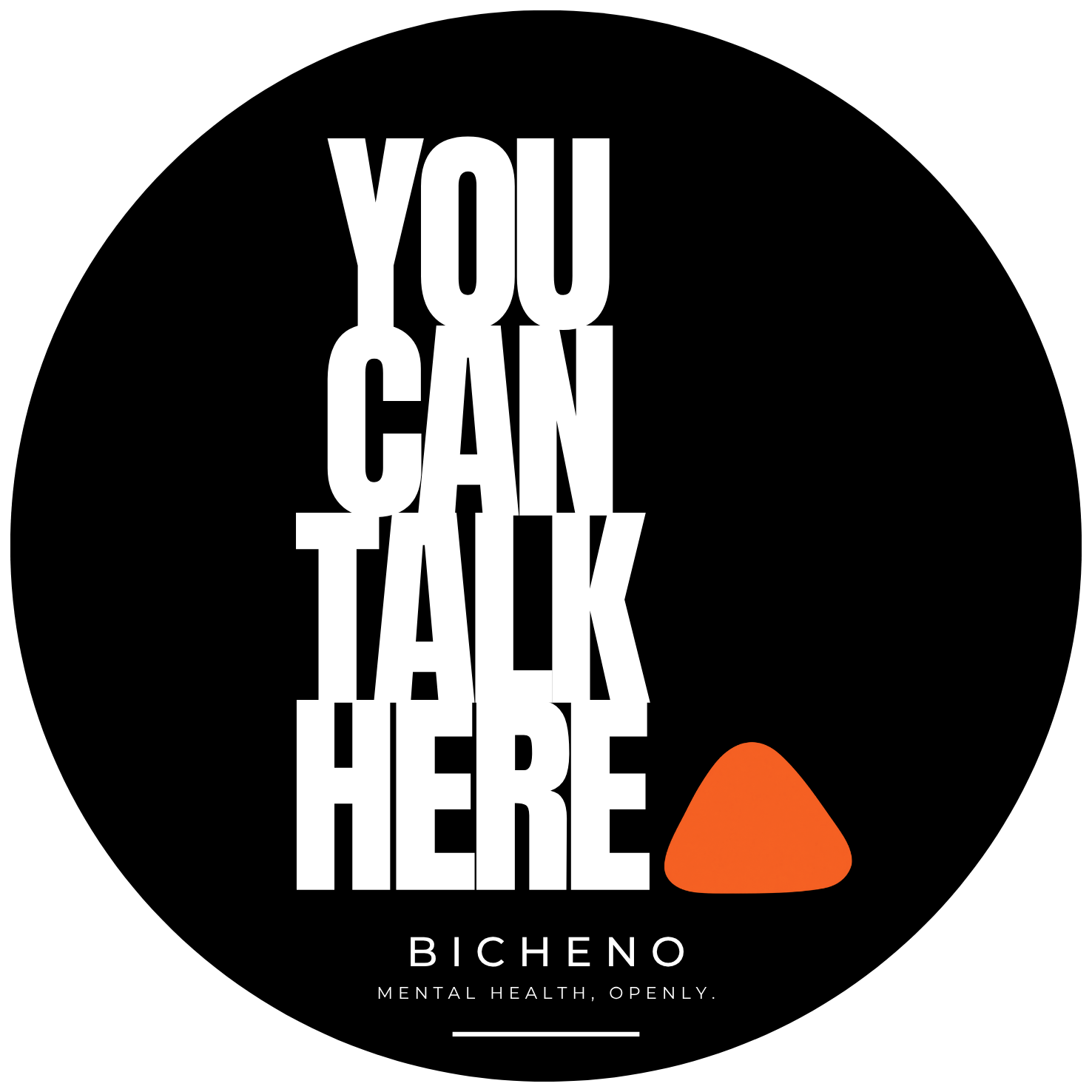
For Bicheno businesses, workplaces, sporting clubs, community groups and organisations, the stickers are free.
Want one for the car, the ute, the shed or home? You can grab a sticker from our shop at cost plus postage. Every dollar goes straight back into producing more stickers and getting the mark out into the community.
Displaying it is simply a way of saying:
We believe these numbers can change, and conversation is one place to start.
As the platform grows, proceeds from merchandise and other activity will be directed back into practical mental-health initiatives for the community, including opportunities such as Mental Health First Aid training and workshops.
Choose orange or black, fill in the form, and we'll get one to you.
Put it on your door. Be part of what it means.
One Small Town.
We don't know exactly where this goes.
And that's okay.
We're starting with something very small.
One town.
One window.
One workplace.
One cafe.
One conversation.
And perhaps, eventually, someone walking through Bicheno will see that black circle on a window and won't need an explanation.
They'll simply know:
You Can Talk Here.
Where This Needs to Go
The idea is bigger than any one person.
I'm an author, an architect, and someone who loves Bicheno and its people. I'm also someone who has known significant mental-health struggles of my own, and who can honestly say that I'm still here because, at some point, I found the courage to be vulnerable: and someone was there to listen.
I can start this conversation, build the platform and push the idea into the world. But YOU CAN TALK HERE. should never belong to me. Ultimately, it needs to belong to the community it exists to serve.
My hope is that YOU CAN TALK HERE. eventually has a home of its own: an independent, charitable organisation that is chaired, governed and directed by people from this community, alongside people with the experience and expertise to help it do genuine good.
An organisation capable of attracting grants, donations, philanthropy and partnerships. One that can turn the goodwill behind this movement into real money, and that money into real things for Bicheno.
Mental Health First Aid training. Community education. Youth initiatives. Better connections to existing services. Bringing expertise into town. Supporting local ideas. Funding things we haven't thought of yet because the people who need them haven't had the opportunity to tell us.
And every dollar raised through YOU CAN TALK HERE. should ultimately help build that capacity.
The sticker on the window is the beginning, not the outcome.
The ambition is to create something with enough credibility, independence and community ownership that it can grow beyond a campaign. Something that can attract serious funding, measure whether what we're doing is working, and keep asking a difficult question:
Can a town change its own mental-health story?
I believe it's worth finding out.
And if something genuinely works in Bicheno, we shouldn't keep it to ourselves. The model should be able to travel to other small towns, other rural communities and other places confronting the same statistics.
It can scale. It can change. It can become something none of us can entirely see yet.
But Bicheno should always be where it began.
Success is a community owning it.
Success is support flowing back into mental health rather than another awareness campaign disappearing when the attention moves on.
Success is more people knowing how to have the conversation. More people getting help earlier. More people feeling that they can tell the truth when they're not okay.
And ultimately, success is much simpler than any brand, organisation or statistic:
people still being here.
That's where I want this to go.
Need to Talk to Someone, Right Now?
Lifeline — 13 11 14 · 24/7
Beyond Blue — 1300 22 4636
13YARN — 13 92 76 · 24/7
StandBy Support After Suicide — 1300 727 247
If you or someone you know is in immediate danger, call 000.