Below The Surface - Peggy’s Point
25-minute read:
There is a silence that belongs only to rock, and Peggy's Point keeps it the way old wounds are kept, deep in the body, beneath a skin that has long since healed over and gone on pretending nothing happened. Stand there on a still morning, the granite still holding the cold of the night in its belly, lichen spreading across its rounded backs in stains the colour of dried blood, of rust, of something that bled once and then, over centuries, simply stopped, and you would swear that nothing here has ever moved, that nothing here could ever move, that this is what permanence looks like when permanence finally consents to hold still and be looked at. The boulders sit the way the old sit, in villages, in nursing homes, on verandas, settled so deep into themselves that stillness seems less a condition than a decision, arrived at long ago and never revisited. It is a lie. It has always been a lie. It is one of the oldest lies landscape tells the living, because the living need it told, need somewhere to stand that is not moving, even as everything beneath their feet is moving, has always been moving, will go on moving long after the word feet has stopped meaning anything at all.
I have walked out onto that granite more times than memory keeps an honest count of, in the way a body walks when a place has stopped being a destination and become instead something closer to a return, feet finding the same worn holds without asking the mind's permission, palm trailing the same warm, curving rock it trailed as a child, the sea doing what the sea has always seemed, in my lifetime, to do: arriving, breaking, withdrawing, arriving again, in a rhythm so faithful, so endlessly repeated, that it reads, wrongly, always wrongly, as eternity. The granite here is famous for being precisely what it is: great rounded monoliths, some no bigger than a clenched fist, others large as a house a family might have lived and died and grieved inside, weathered into the soft-shouldered, sun-warmed forms that make this whole coast, from here up through Freycinet and further still, one of the most photographed shores in the country, endlessly reproduced on postcards and calendars by people who believe, because the rock invites them to believe it, that they are looking at the whole of the story. The rock ends. The water begins. The line between them is clean and drawn, you assume, more or less where it has always been drawn, the way a border on an old map looks permanent simply because no one alive remembers it being argued over.
There is a species of person (I have long since stopped pretending I am not one of them) for whom that clean line never quite settles into fact. It is not disbelief, exactly. It is closer to grief that has not yet been given its object: a persistent, unglamorous ache that will not be argued out of itself, a suspicion that the coast on offer, bounded by a car park, a track, a laminated sign with a whale or a penguin on it, is a summary, and that every summary is, by its nature, also a burial. You look at the boulders and cannot help wanting to know what they looked like from further back, or further down, or from beneath. It is the same hunger that sends some of us back through a family tree at two in the morning, or out to stand in a paddock where a homestead used to breathe smoke into a Tasmanian sky, or into an archive hunting a name some clerk never thought worth the ink to spell correctly. It is not a wish to flee the present. It is a refusal, quiet, stubborn, entirely unfashionable, to believe the present is the whole of what there is. Most of what I have ever written has come from exactly that refusal: a wanting to know what this coast looked like before the ice finished its long, grudging retreat, before the sea settled into the shape we now call natural, as though natural and permanent had ever, in the whole violent history of water, been the same word.
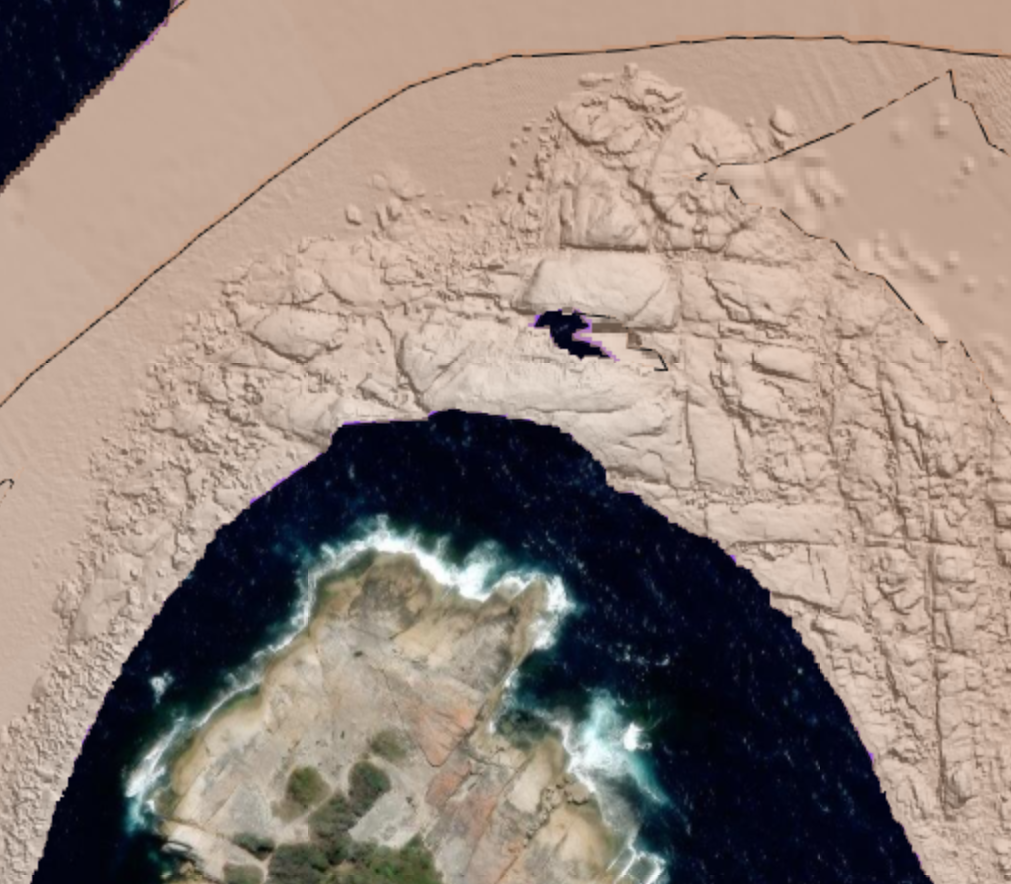
And then an image of the Bicheno seabed arrives, made by instruments that share none of our impatience, that can see through water the way grief sees through years, and the clean line dissolves the way all clean lines eventually dissolve when someone finally looks properly. Beneath the place where the waves break now, in water that from the point looks like nothing but colour and depth and the accumulated dark of centuries, the seabed rises into shapes the eye recognises before the mind has finished arguing about what it is seeing. The same rounded backs. The same clustered, fractured, weathered forms, split along the same deliberate joints, scattered across the sea floor in a pattern any child who has ever scrambled barefoot across Peggy's Point would know instantly in the soles of their feet, because it is the same family of stone, the same blood, continued only a little further out, and a little further down, than we have been taught to look.
It is an image of what the water has been hiding, taken by a machine that does not care about wonder, does not care about grief, does not care about any of the things a person standing on that granite might feel looking at it: And is, for exactly that reason, more devastating than any photograph a person could have taken with wonder or grief in mind. Look closely and the story only grows more precise, and stranger for its precision. Onshore, rendered in the warm, the land rises in the same tumbled, boulder-strewn texture the body remembers from every scramble across this point: crests and clefts, smoothed hummocks, a scatter of individual rocks standing slightly proud of their neighbours, the way in every family photograph one relative always stands a half-step forward, unable to help themselves. A thin black line. a survey boundary, a park limit, some bureaucratic fiction laid reverently over four hundred million years of rock, threads its way across the frame, entirely unconcerned with where the granite actually is or is not, a reminder, as if any were needed, that most lines drawn on maps are conversations governments have with each other, not with the earth.
Then the ground gives way to water. Close to where the two meet, beneath a surface rendered by the cartographer's hand as a flat, drowned black, there is a paler smear, a wound of paleness where the water is shallow enough, the seabed hard enough, for the instrument to find shape where it expected only void and kelp. And within that paleness: the same broken, jointed geometry the hand knows from the rocks above. A scatter of forms with the unmistakable rounded shoulders of granite corestones, resting on the sea floor in a cluster that mirrors, almost mockingly, almost tenderly, the cluster sitting in the sun not fifty metres away, warmed by the same light that will never again reach its drowned kin. To the south a small rocky islet holds its ground against a collar of white water, waves breaking around it in the lacework only a hard outcrop can force from the sea's relentless insistence. A small, present-tense demonstration, still happening, still being decided, of exactly the process that once happened, on a vaster and slower scale, to the drowned forms lying just to its north. The island is what a headland looks like while it is still fighting. The pale smear beneath the water is what a headland looks like once the fight is over, and the sea, patient beyond any patience we possess, has finally been given what it wanted.
What the scan offers, then, is not an artist's grief made visible, not an imagining. It is a photograph of loss, made legible by an instrument built to be more patient than sorrow. And once you have seen it, once you have let yourself see it properly, you cannot walk out onto Peggy's Point again believing you stand at an edge. You stand, instead, somewhere in the middle of something far larger than the headland, on the still-exposed remnant of a body whose greater portion has already gone under, and whose remaining portion will, on a clock long enough, follow.
—————————
To understand why that granite exists at all, in this shape, in this exact and stubborn place, you must go back further than water, back past ice ages, past the first human footfall on this coast, into a darkness so old the word history embarrasses itself trying to reach it. Somewhere close to four hundred million years ago, in the Devonian, deep beneath what would one day, unimaginably far in its future, be called Tasmania's east coast, rock melted. Great reservoirs of magma, forced upward by the slow violence of colliding, buckling crust, pooled in chambers kilometres beneath the surface and there, in the dark, over spans of time the word slow cannot honestly serve, cooled into the coarse, glittering, feldspar-flecked stone we call granite. It never breached the surface as fire. It never announced itself. It solidified entombed, patient in the total, absolute patience only rock in the dark can practise, waiting, though waiting is too active a word for something that does not know it waits, beneath everything that would, in time, be worn away to expose it.
The second half of the story takes nearly as long as the first: exhumation, the slow unburying. For hundreds of millions of years the rock lying above that cooling batholith, sediment, older stone, whole vanished landscapes we will never have names for, was stripped away by rain, by river, by the unglamorous, unceasing labour of weather, until the granite itself stood close enough to the surface for water to find its way into the joints. Granite does not weather smoothly, the way a story does not grieve smoothly. It weathers along its fractures, along the seams laid down as it cooled and as later tremors flexed and cracked the stone, water working into those wounds and rotting the rock softly from within, rounding first the corners of each buried block, deep underground, hidden beneath a soft shroud of decayed material geologists call regolith, a shroud that for millions of years kept the transformation from any eye, because there was no eye yet living to keep it from. Only when that shroud was itself eroded, stripped by rain, by river, and finally by the sea, did the rounded corestones beneath it stand revealed: the great tumbled boulders of Peggy's Point, of Freycinet, of this whole granite coast, are not sculptures the ocean carved with any tenderness or intention. They are ghosts of an older, slower carving, done in blindness, under soil, across a span of time no human grief has ever been asked to hold, and only now, only recently, unveiled by the erosion of everything that once buried them from view.
This matters more than geology usually cares to matter, because it means the drowned forms offshore are not some lesser, younger, second category of stone. They are the same blood, weathered by the same blind and patient process, on the same unthinkable clock, as the boulders warm enough to sit on today. The only difference between the tor your hand can rest on this morning and the tor lying drowned fifty metres out is a difference of address, not of kind, a difference explained entirely by what has happened to the water, and not at all by what has happened to the rock. The granite has been patient in the manner granite has always been patient, which is to say without knowing the word. It is the sea, restless, grieving, endlessly returning, that has done all the moving.
—————————
To understand what happened to the water, you must go somewhere colder, somewhere further back than any grief this coast currently keeps. Around twenty thousand years ago, a heartbeat, geologically, though it sits at the very furthest edge of what human culture on this earth still carries as living memory, the planet lay locked in the depths of the last glacial period. Ice sheets kilometres thick lay over what would become Canada, over Scandinavia; sea ice held its ground longer and further around a colder Antarctica; and because so much of the world's water was bound as ice upon the land, the oceans themselves stood some hundred and twenty metres lower than the water now breaking at your feet. A hundred and twenty metres is not a subtle number. It is a forty-storey building, laid flat, and subtracted from every coastline the world has ever owned.
For this coast, that meant the shoreline sat kilometres further out than it does now, somewhere near the drowned lip of what we today call the continental shelf. The cliffs and headlands we have learned to think of as the coast, Peggy's Point among them, were not coastal at all. They stood inland, above a wide, cold, wind-scoured plain reaching away toward a sea none of us has ever seen and none of us ever will, except in this indirect, ghost-lit way an instrument now allows. We cannot know that vanished plain with any honesty of detail. It would have been colder than this coast, and drier, the vegetation more open, closer to grassland and low wind-flattened heath than to the wet, crowding eucalypt forest that presses down to the water's edge today, shaped by winds that came off a country still remembering ice in its bones. It is the kind of country the mind must build, rock by rock, rather than the kind the eye is permitted to receive: a wide plain running east from what are now inland hills, cut by rivers travelling toward a coastline that has not existed, in any form a human foot could stand upon, for well over ten thousand years.
It was on that plain, and on plains like it scattered across the continent and its drowned margins, that people were living. Not visiting. Not passing through on the way to somewhere the history books have decided mattered more. Living, hunting, grieving, singing their dead into whatever the sky was called then, teaching children the names of rivers that no longer exist to be named.
Then, slowly, and then not slowly at all, the ice began to give the water back.
The mechanism, at its cold and patient heart, is a matter of angles and orbits: the earth's tilt and its slow orbital wobble shift across tens of thousands of years, in cycles altering how much summer light falls upon the high, ice-bound latitudes. Around twenty thousand years ago, that ancient clockwork tipped toward fiercer high-latitude summers, and the great ice sheets of the north began, tentatively at first, the way any long grief begins, to lose more of themselves each summer than winter could give back. Once that imbalance took hold it fed on itself, the way all grief eventually feeds on itself: bare, dark ground and open water absorb heat that ice and snow would have thrown back to the sky, so every retreat of the ice warmed the land and sea a little further, which melted a little more ice, in a slow conflagration that would, over ten or fifteen thousand years, return the ocean's stolen hundred and twenty metres.
It is tempting, and not entirely wrong, to imagine that return as gradual: millimetres a year, the patient arithmetic of melting ice averaged out across the deep breath of millennia, the kind of number that lets the mind rest easy. But the record kept in drowned reefs and buried shorelines around the world tells a rawer story. There were long, quiet centuries, and then there were pulses. One, most infamous among the scientists who study such things, occurring close to fourteen and a half thousand years ago and known coldly, clinically, as Meltwater Pulse 1A, during which the sea appears to have risen several metres within a few hundred years, as some threshold in the collapsing ice was crossed and the ocean took back, in a geological instant, what had taken millennia to steal. To a person alive through, such a pulse, this would not have felt like a slow arithmetic. It would have felt like catastrophe within a single remembered life, a beach that had always been there, gone within a grandmother's telling; a river mouth that no longer reached the sea where it always had; camps moved, and moved again, and moved once more, until moving became its own kind of ceremony.
By around seven thousand years ago, that long convulsion had largely spent its violence. The rate of rise slowed as the great northern ice sheets finished their retreat, and the sea settled into something close to the shape it holds now, drifting only slightly across the millennia since. The coastline we know, the one Peggy's Point currently, briefly, magnificently guards, is, in the fullest geological accounting, a recent and quite possibly temporary arrangement. It has held its present shape for perhaps a tenth of the time people have walked this island. A tenth. Say that number slowly and see what it does to the ground beneath your feet.
Nowhere is that long unmaking written more plainly than in the strait now lying between this island and the rest of the continent it was once, and only once, and long ago, joined to. As the ice retreated and the sea rose through those closing millennia, the broad land connection across what is now Bass Strait did not vanish all at once, the way a story never ends all at once either. It narrowed. Researchers who have reconstructed the drowned floor of the strait, working from data much like the scan of Peggy's Point, have shown that by around twelve thousand seven hundred years ago the crossing had shrunk to a corridor perhaps five kilometres wide, still walkable. Within a few hundred years more, it was gone. The connection failed somewhere close to twelve thousand years ago, and this island, Lutruwita, became, for the first time in tens of thousands of years of human memory, an island in truth as well as in name. Because the floor of Bass Strait lies unusually flat, the final stages of that flooding are thought to have moved with a speed capable, in places, of the sea swallowing twenty metres of ground in a single year, slow, by the measure of a flood, but fast enough that a person setting out across the crossing might, within their own remembered lifetime, have found the way home already drowned behind them. The strait went on widening and deepening for millennia afterward as the sea climbed toward its modern stand, reaching something close to its present breadth and depth by around eight thousand years ago.
This coast, Bicheno's own coast, was reshaped by exactly the same rising water, on exactly the same unforgiving timeline. As the sea crept in across the old plain to the east, it did not arrive at Peggy's Point and simply stop, the way water never simply stops. It came further. The granite tors now lying drowned in the shallows just offshore, the very forms the scan has given back to us, mark a shoreline the sea held for some span of that long transgression: a place where, for a time, this was where the waves broke, where sediment was scoured from around the exposed corestones exactly as it is being scoured, this morning, from around the boulders you can still put your hand to; where the granite's true weathered shape was being freshly unveiled by the same collaboration of surf and current that continues its old work today. And then the sea did not stop there either. It rose further, by metres more across the centuries that followed, until the breaking waves withdrew, or advanced, depending which of them you ask to tell the story, to where they meet the rock now, leaving that earlier shoreline drowned behind them, its granite still bearing the shape the waves gave it, but no longer touched by them: a coastline retired, and grieving, in the only way stone knows how to grieve, which is silently, and forever.
————————-
None of this happened to an empty country. For the whole span of the last glacial age, through the plain's slow drowning and the strait's widening, through the violent pulses and the long quiet centuries between them, people were living on this coast, on every coast this island owns, watching it happen with their own eyes, in their own bodies, in the only kind of witnessing that leaves no bathymetric trace and yet, it turns out, leaves a trace anyway. The stretch of shore that holds Bicheno was/is the country of the Paredarerme, known also as the Oyster Bay nation: ten bands, some seven or eight hundred people in total, moving with the seasons between coast and highland, wintering near this water to take shellfish, fish, seal, muttonbird, travelling inland in the warmer months to a high country that was, in its own way, just as much home.
That continuity is the whole of what matters here, because it means the people whose country this was did not arrive after the great drowning had already finished its work. They were here for it. Human presence on this island reaches back at least sixty thousand years, deep enough to hold, within a single unbroken thread of culture, the entire slow catastrophe of the Bassian land bridge's failure, and it is here, at exactly this point, that the story this seabed image tells stops being only geological and becomes something far rarer, and far more devastating: a story that survived, entire, in two utterly different kinds of memory at once. One memory is rock, the drowned corestones, the bathymetric record, the patient physical fact an instrument can drag up from beneath the waves. The other memory is breath. Is voice. Is the oldest kind of archive there is.
Stand at Peggy's Point holding that fact and the seabed scan will not let you go so easily again. It stops being merely a geological curiosity, a pretty piece of instrumentation. It becomes a second, wholly independent witness to an event that was already, and separately, being kept alive in language: two archives, one carved in submerged granite and read now by machine, the other carried in voice and kept, against every violence the following two centuries could throw at it, by careful and unbroken telling, both of them converging, if you let them, on the same drowned country, the same vanished plain, the same rising, indifferent, endlessly patient water.
————————
What, then, does it mean to look at a scientific image like this one and feel, as I do, something closer to reverence than to mere interest?
I think it has to do with what the image quietly, mercilessly insists upon: that the line we draw between land and sea, the line that feels to us like one of the most stable facts the world has ever offered, is nothing of the kind. It is a truce, current, but temporary, between a planet's water and a planet's rock, renegotiated on a clock too slow for any single life to witness in full, and yet, astonishingly, not too slow for one human culture to have watched happen and to have kept telling the story of it, unbroken, generation folded into generation, until an instrument built centuries later could finally confirm what the voices had been saying all along. We are used to believing coastlines are the fixed edge against which everything else, tide, weather, the small daily business of a life, is measured. A map draws the coast as a solid line, as though someone, once, had gone out and settled the matter for good. But a coastline, it turns out, is closer to an old argument than a settled fact: an ongoing negotiation between rock that yields slowly and water that never once stops asking, a negotiation that has produced a different answer in every age of this planet's long, unfinished life, and will go on producing different answers long after everyone currently able to walk Peggy's Point has stopped being able to walk anywhere at all. What the scan gives us is simply a rare, unbidden glimpse of one of the argument's earlier drafts, still lying where the water left it, still faithfully holding its shape, waiting, though waiting is too generous a word for rock, to be seen.
The granite at Peggy's Point does not know it currently stands on the winning side of that truce. It has been drowned before, in earlier configurations of this same coast, further back than this article has dared to reach, and it will very likely be drowned again, whether by the slow continuation of the old natural cycles or by the sharper, human-authored rise now measured, coldly, at gauges up and down this coast and around the world. The rock's patience is not indifference, whatever it might look like from a car park. It is simply a patience operating on a clock so vast it makes our own patience look, by comparison, like the length of a single indrawn breath.
Tasmania is an island that keeps its history in layers, some buried in soil, some buried in silence, some, it turns out , buried under water clear enough, when the light and the instruments align, to still show us the shape of what was lost. To go looking for the drowned plain off this coast is to practise a very particular, very old kind of attention: attention to a country that no longer exists in any form we could walk across, but has not entirely vanished either, because its shape persists in rock the sea could not quite erase, and because its memory persists in a language and a people who never stopped being its custodians, whatever else was taken from them in the two centuries since. Curiosity about what lies below the waterline, followed far enough, stops being simple curiosity. It becomes an act of keeping faith, with the granite, which has been patient with us far longer than we deserve; and with the Paredarerme people, whose ancestors watched this exact drowning happen in the unbearable slowness of real time, and whose descendants are still here, on this coast, still telling it, still owed the telling of it properly.
————————
Back at Peggy's Point, none of this shows on the surface. The waves arrive, break, withdraw, arrive again, in the rhythm they have always kept for as long as anyone now living has known this place, a rhythm that asks nothing of us but to stand still and be, briefly, comforted by it. The lichen is still the colour of rust, of dried blood, of something old enough to have stopped grieving out loud. The rock is warm by midmorning and cold again by dusk, the way it has been every day within any memory this coast still holds. It would be the easiest thing in the world, standing there, to mistake the present shoreline for the only shoreline there has ever been, and to walk away no wiser than you arrived.
But somewhere past the break, under water dark enough to keep its secrets from anyone lacking the patience or the instruments to look properly, the same blood of granite continues, rounded, weathered, unmistakably itself, unmistakably kin, marking the place where this coast used to end, before the ice gave the sea back its stolen hundred and twenty metres, before a five-kilometre isthmus narrowed and failed and turned an island's whole future in on itself, before a wide plain full of rivers, and, we must presume, full of people, full of fires lit against a colder dark than this one, went under for good. It is still there. It has only changed its address, the way this whole coast has changed address before, and will again, on a clock long enough, patient enough, to make even the most stubborn human curiosity feel, for one clear moment, wonderfully, appropriately small, and, for that same moment, entirely, achingly alive.
AM -